

What Is a Tourbillon Watch? How It Works & Why It Costs More
A tourbillon watch is one of the most fascinating designs in mechanical watchmaking. Its rotating mechanism can be seen through an opening in the dial, revealing the tiny components working together to regulate time. But what exactly is a tourbillon, why is it associated with luxury watches, and is it worth buying one?
The answer depends on what you value in a watch. A tourbillon can represent intricate mechanical engineering, visual appeal and traditional watchmaking craftsmanship. However, it does not automatically make a watch more accurate than every other mechanical watch.
In this guide, you will learn what a tourbillon watch is, how its movement works, why these watches can be expensive, and what to check before buying one. If you are interested in a statement timepiece with visible mechanical details, we will also show you how to explore relevant designs at Gift Lux Watch.
What Is a Tourbillon Watch?
A tourbillon watch is a mechanical watch that incorporates a tourbillon mechanism. This mechanism places key timekeeping components, particularly the balance wheel and escapement, inside a rotating cage.
The cage rotates as the watch runs, changing the orientation of those components. The original aim was to reduce certain positional errors caused by gravity, especially in pocket watches that remained in a relatively fixed position for long periods.
The word tourbillon comes from French and means “whirlwind,” an appropriate name for a mechanism built around continuous rotation.
A tourbillon is considered a sophisticated feature in traditional watchmaking because the mechanism is intricate, delicate and challenging to design, assemble and regulate.
Looking for a watch with a striking mechanical design? Explore the Gift Lux Watch men's collection to compare different styles, including automatic and skeleton watches.
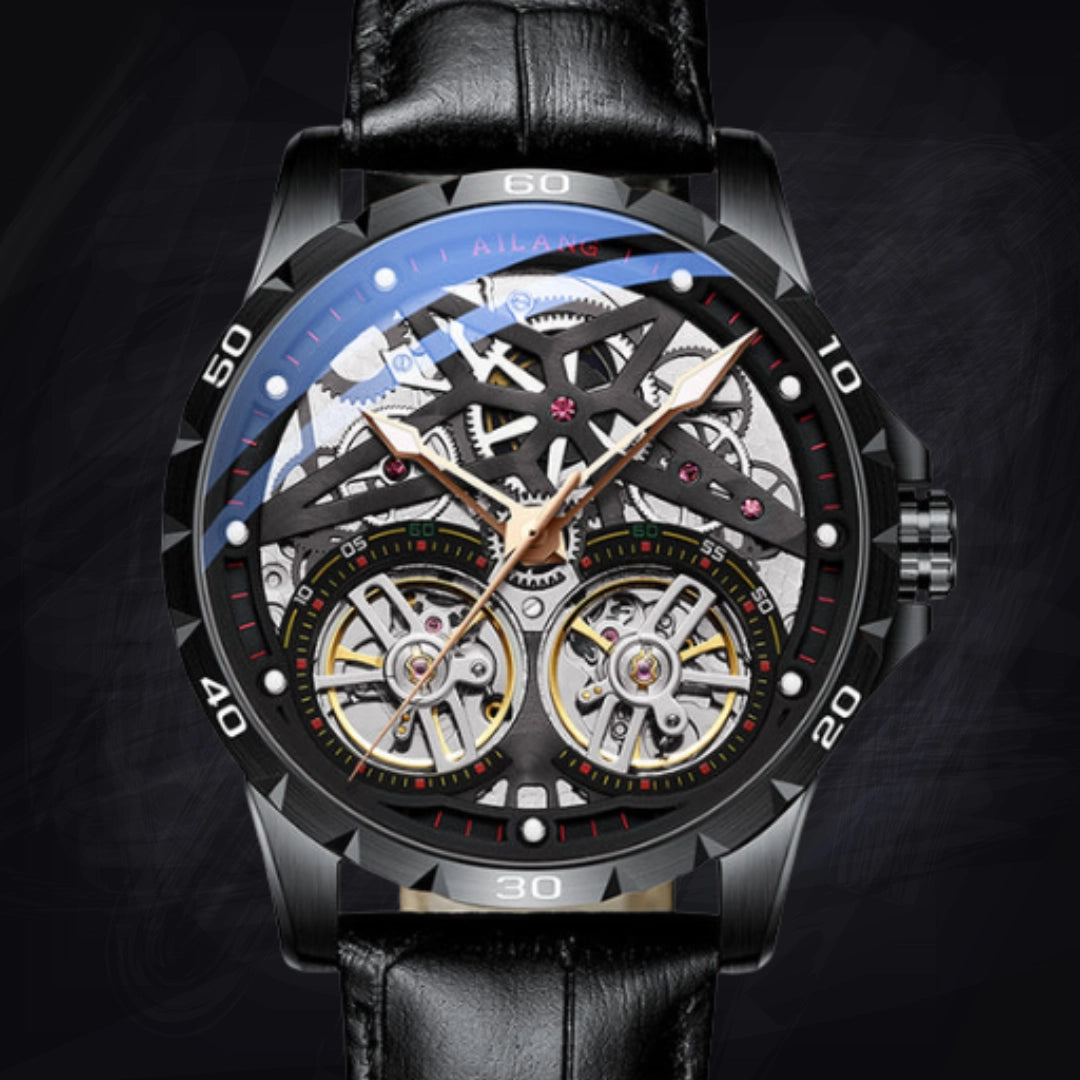
How Does a Tourbillon Work?
To understand a tourbillon, it helps to know the basics of a mechanical watch.
A mechanical watch stores energy in a mainspring. The gear train transfers that energy, while the escapement releases it in controlled intervals. The balance wheel and hairspring regulate the timing of those intervals, allowing the hands to display the time.
In a traditional tourbillon, the balance wheel, hairspring and escapement are mounted inside a small rotating cage.
Here is how the mechanism works:
- The mainspring supplies energy. Winding the watch stores energy that drives the movement.
- The gear train transfers that energy. The wheels and pinions transmit power through the mechanism.
- The escapement regulates the release of energy. It works with the balance wheel and hairspring to control timekeeping.
- The tourbillon cage rotates. The regulating components change orientation as the cage turns, helping average certain positional timing errors.
- The hands display the time. The watch continues to function as a timepiece while the tourbillon adds mechanical complexity.
Many traditional tourbillons complete one rotation in approximately 60 seconds, although designs can differ. The exact mechanism and rotation rate depend on the caliber.
One of the most appealing aspects is that the rotation can be visible through an opening in the dial. It gives the wearer a view of a working mechanical assembly rather than a static decorative detail.
What Does a Tourbillon Do in a Watch?
The original purpose of a tourbillon was to address the effect of gravity on the regulating components of a mechanical watch.
When a pocket watch remains in one position for a long time, positional differences can affect its rate. Rotating the regulating assembly can help average some of those errors.
Modern wristwatches are worn in changing positions throughout the day, so the practical accuracy benefit of a tourbillon is not guaranteed. A well-regulated conventional mechanical watch may keep time better than a particular tourbillon watch.
Today, a tourbillon is valued for several reasons:
- Mechanical craftsmanship: The mechanism requires careful design and assembly.
- Visual interest: A visible rotating cage creates movement on the dial.
- Watchmaking heritage: Tourbillons have a long association with advanced mechanical watchmaking.
- Collector appeal: Enthusiasts may value the complexity and engineering involved.
The important distinction is that a tourbillon is not a shortcut to perfect accuracy. Its appeal lies in a combination of engineering, tradition and visual character.
Why Are Tourbillon Watches So Expensive?
Tourbillon watches are often associated with high prices because the mechanism adds engineering and manufacturing challenges beyond those of a conventional mechanical movement.
Several factors can contribute to the cost.
1. Complex movement construction
The tourbillon cage must hold delicate regulating components while rotating. Its parts need to work together without disrupting the movement's operation.
2. Precision assembly and regulation
Small errors in assembly, balance or adjustment can affect performance. Depending on the caliber, building and regulating the mechanism can require considerable specialist skill.
3. Finishing and craftsmanship
Some high-end tourbillons feature hand-finished bridges, polished components and elaborate movement architecture. These details can add significant labour and cost, although finishing varies from one watch to another.
4. Materials and overall watch construction
The case, crystal, dial, movement materials, production volume and brand positioning all influence retail price. A tourbillon alone does not tell you whether a complete watch offers good value.
5. Rarity and market positioning
Some tourbillon watches are produced in limited quantities and positioned as collector pieces. Rarity and brand reputation can influence price independently of practical timekeeping performance.
Buying tip: Do not judge a tourbillon watch by its price alone. Check the movement specifications, construction, warranty, return terms and the details that are actually documented by the seller.
Types of Tourbillon Watches
Tourbillon mechanisms come in several designs. The main differences relate to how the rotating cage is supported, how many axes it rotates around, and how the mechanism is displayed.
1. Traditional tourbillon
A traditional tourbillon uses a rotating cage supported by the movement's structure. It is the classic form associated with the original concept.
2. Flying tourbillon
A flying tourbillon is supported from one side rather than being held between upper and lower bridges in the conventional way. This can make the rotating mechanism appear to float above the movement.
3. Multi-axis tourbillon
A multi-axis tourbillon rotates around more than one axis. The design is more complex and is generally associated with specialist, high-end mechanical watchmaking.
4. Double or multiple tourbillons
Some watches use two or more tourbillon mechanisms. These designs can be technically demanding, but the number of tourbillons does not automatically establish that a watch is more accurate or better value.
An important buying distinction: tourbillon vs tourbillon-style
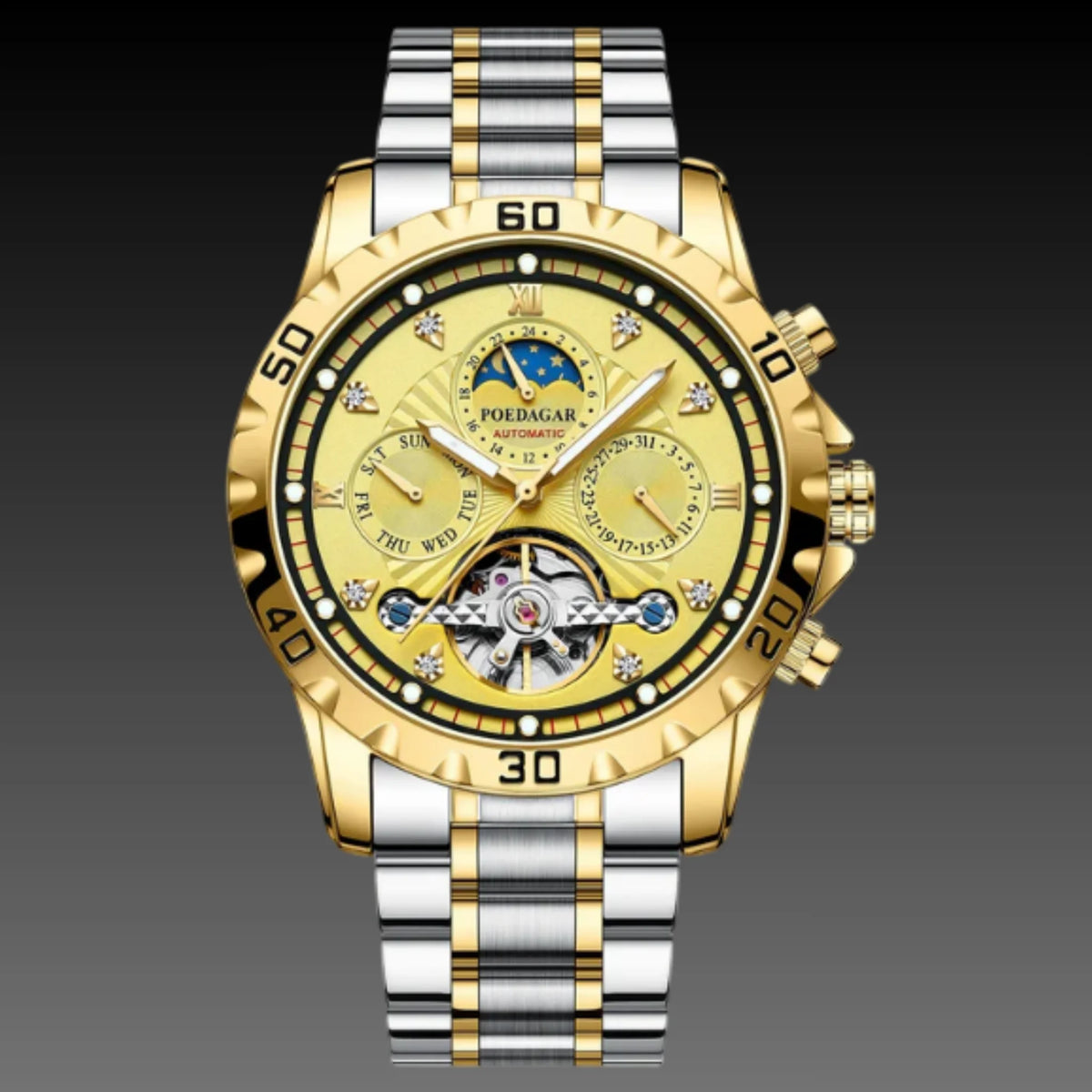
A watch can have an open-heart window, a skeleton dial or a moving balance wheel without necessarily containing a true tourbillon.
An open-heart design exposes part of the movement. A skeleton watch reveals more of the mechanism. A true tourbillon has a rotating cage that carries the regulating components.
If a listing uses terms such as “tourbillon style,” “open heart” or “tourbillon design,” check the technical specifications carefully before assuming that it contains a genuine tourbillon mechanism.
Tourbillon vs Automatic Watch: What Is the Difference?
These terms describe different things.
An automatic watch is a mechanical watch that winds its mainspring through the movement of a rotor as the wearer moves their wrist. It may also allow manual winding through the crown.
A tourbillon is a mechanism within a mechanical movement. A tourbillon watch may be automatic or manually wound, depending on its design.
| Feature | Automatic watch | Tourbillon watch |
|---|---|---|
| What the term describes | A winding method | A rotating regulating mechanism |
| Main purpose | Winding the mainspring through wrist movement | Originally designed to address positional timing errors |
| Requires a battery? | Usually no | A traditional mechanical tourbillon does not require a battery |
| Mechanical complexity | Varies by caliber | The tourbillon adds a complex mechanism |
| Best reason to choose it | Mechanical convenience and craftsmanship | Interest in intricate mechanics and distinctive design |
A tourbillon is not simply a more advanced synonym for automatic. One describes how a watch is wound; the other describes a specific mechanism.
To learn more about the different ways watches keep time, read our watch movement types explained for beginners guide.
Are Tourbillon Watches More Accurate?
Not necessarily.
The original tourbillon design was intended to reduce certain errors caused by the effect of gravity on a watch's regulating components. That was particularly relevant to pocket watches that spent much of their time in a fixed orientation.
Modern wristwatches move throughout the day, and their accuracy depends on several factors, including:
- Movement design and manufacturing quality.
- Regulation and adjustment.
- The watch's position when it is not being worn.
- Temperature, shocks and magnetism.
- Maintenance and the condition of the movement.
A tourbillon may be extremely sophisticated, but its presence alone does not prove that the watch keeps better time than a conventional mechanical watch.
If your priority is dependable everyday timekeeping, compare the stated accuracy and specifications of the actual watches you are considering. If your priority is visible mechanical craftsmanship, a tourbillon may offer a different kind of appeal.
Are Tourbillon Watches Worth It?
A tourbillon watch can be worth buying if you appreciate the mechanism, its appearance and the craftsmanship associated with it. Whether it represents good value depends on your expectations and the specific watch.
A tourbillon may be right for you if:
- You enjoy mechanical watchmaking and intricate movement designs.
- You want a distinctive watch that can become a conversation piece.
- You appreciate the engineering and visual movement of a rotating cage.
- The price, warranty and service arrangements suit your budget.
You may prefer a conventional automatic if:
- You mainly want a reliable everyday watch.
- Accuracy and low-maintenance ownership matter more than complications.
- You want visible gears or an open dial without specifically needing a tourbillon.
- You would rather spend your budget on the case, crystal, finishing or overall design.
There is no universal answer. The best watch is the one that matches your priorities without requiring you to pay for a feature you do not particularly value.
Explore Tourbillon and Mechanical Watch Designs at Gift Lux Watch
If you are interested in the appearance and engineering of mechanical watches, start by comparing the exact features listed for each design.
1. Star Tourbillon Mechanical Watch
This Gift Lux Watch listing identifies a mechanical movement and lists “Tourbillon” as a special function. It also lists a 43 mm dial diameter and sapphire crystal glass. Review the full product listing for the selected finish, current availability and complete specifications before ordering.
2. Great Wall Series Tourbillon Mechanical Watch
This design is listed as a tourbillon mechanical watch and offers dial and colour variations. Review the current product details to compare the style and available options.
3. Men's Skeleton Automatic Watch
If you mainly want to see mechanical components in action, this skeleton automatic design offers an open-worked dial and an exhibition caseback. It is an alternative for buyers who value visible mechanical details without necessarily requiring a tourbillon.
These products are not interchangeable in technical terms. A skeleton or open-heart design should not be treated as proof of a genuine tourbillon, and the product specifications should be checked before purchase.
Want more options? Browse the men's watch collection, compare styles in the featured watches collection, or explore the luxury watch collection.
How to Choose a Tourbillon Watch Before Buying
Before placing an order, use this checklist to compare watches and avoid paying for assumptions rather than documented features.
Confirm the mechanism. Check whether the product specifies a true tourbillon, a flying tourbillon or a tourbillon-style/open-heart design. Ask the seller if the mechanism is unclear.
Check the movement details. Look for the movement type, caliber information and any technical documentation provided.
Review the case dimensions. Case diameter and thickness affect how the watch will sit on your wrist. If you are unsure about sizing, use our guide to measuring your wrist for a watch.
Check the crystal and case materials. Verify the materials listed for the specific model and selected variant rather than assuming every finish uses identical components.
Understand the water-resistance rating. Water resistance is not the same as guaranteed suitability for swimming or showering. Follow the rating and care guidance provided for the particular watch.
Review warranty, shipping and returns. Read the current terms before buying, especially if the watch is intended as a gift.
Choose based on your reason for buying. If you love the visible mechanism, prioritize the dial and movement design. If you need a daily watch, consider comfort, readability, durability and servicing alongside appearance.
Frequently Asked Questions
What is a tourbillon watch in simple terms?
A tourbillon watch is a mechanical watch with a rotating cage that holds key timekeeping components, including the balance wheel and escapement. The mechanism was originally developed to help reduce certain positional timing errors caused by gravity.
What does tourbillon mean?
Tourbillon is a French word meaning “whirlwind.” In watchmaking, it refers to a rotating mechanism inside a mechanical movement.
How does a tourbillon watch work?
The movement places its regulating components inside a cage that rotates while the watch runs. This changes their orientation and can help average some positional errors. The watch continues to display the time through its normal gear train and hands.
Does a tourbillon watch need a battery?
A traditional mechanical tourbillon does not require a battery. It uses mechanical energy from a mainspring, supplied by manual winding or an automatic winding system depending on the watch.
Are tourbillon watches worth the money?
They can be worth the money for buyers who appreciate their engineering, craftsmanship and visual appeal. They are not automatically the best choice for everyday accuracy or value, so compare the actual movement and overall watch before buying.
Are all watches with a visible rotating dial a tourbillon?
No. An open-heart window, skeleton movement or decorative rotating feature is not necessarily a true tourbillon. Look for specifications confirming that the regulating components are mounted inside a rotating cage.
What is the difference between a flying tourbillon and a regular tourbillon?
A conventional tourbillon cage is supported by bridges in the movement. A flying tourbillon is supported from one side, giving the mechanism a more open, floating appearance.
Is a tourbillon the same as an automatic watch?
No. Automatic describes how a mechanical watch winds its mainspring using a rotor. Tourbillon describes a rotating mechanism within the movement. A watch may combine both features, but one does not automatically imply the other.
Final Thoughts
A tourbillon watch combines a distinctive rotating mechanism with the engineering traditions of mechanical watchmaking. It was originally designed to address positional timing errors, but today its appeal also comes from the complexity and movement visible on the dial.
If you are shopping for one, focus on the actual mechanism, documented specifications, case design, warranty and overall value—not just the word “tourbillon” in a product title.
Ready to explore your options? Start with the Star Tourbillon Mechanical Watch, compare it with other featured watches, or browse the full men's watch collection to find a design that fits your style and budget.
Related Posts
Swiss vs Japanese Watch Movements: Which Is Better?

Deployant Clasp: What It Is and How It Works

How to Adjust a Watch Band: Step-by-Step Guide

5 ATM Water Resistance: What It Means for Your Watch

Which Wrist to Wear a Watch On? Left or Right?
How to Clean a Stainless Steel Watch Safely
