
Swiss vs Japanese Watch Movements: Which Is Better?
Choosing between Swiss and Japanese watch movements can feel like choosing between tradition and practicality. Swiss watchmaking is associated with mechanical craftsmanship and luxury, while Japanese manufacturers are known for producing a wide range of dependable movements at different price points.
But which one is actually better?
The answer depends on the movement inside the watch, its accuracy specifications, power reserve, servicing requirements and the experience you want from wearing it. A well-regulated Japanese automatic can be a sensible everyday choice, while a Swiss movement may appeal to someone who values a particular caliber, its finishing or its watchmaking heritage.
This guide compares Swiss vs Japanese watch movements in practical terms, explains the differences between manufacturers such as Miyota, Seiko, ETA and Sellita, and helps you decide what matters most before buying your next watch.
Swiss vs Japanese Movement: Quick Comparison
| Feature | Swiss movements | Japanese movements |
|---|---|---|
| Well-known manufacturers | ETA, Sellita and others | Miyota, Seiko and others |
| Price positioning | Often associated with mid-range and premium watches, depending on the caliber | Available across budget, mid-range and premium segments |
| Accuracy | Depends on the movement type, grade, regulation and certification | Depends on the movement type, grade, regulation and certification |
| Mechanical options | Automatic, manual-winding and specialized calibers | Automatic, manual-winding and specialized calibers |
| Quartz options | Available | Widely available |
| Power reserve | Varies by caliber | Varies by caliber |
| Maintenance | Depends on movement design, parts availability and local service expertise | Depends on movement design, parts availability and local service expertise |
| Best reason to choose one | A specific caliber, finishing, heritage or watch design | A specific caliber, value, practicality or watch design |
The takeaway: Neither country automatically produces the better movement for every buyer. Compare the actual caliber and the complete watch rather than relying on the country printed on the dial.
What Is a Swiss Watch Movement?
A Swiss watch movement is the mechanism that powers a watch and is manufactured or assembled under the relevant Swiss production standards. Swiss watchmaking includes a broad range of products, from accessible quartz watches to sophisticated mechanical calibers.
Two names worth knowing are ETA and Sellita. Both manufacture movements used by watch brands, although the exact caliber, grade and specification differ between models.
Swiss movements are often associated with:
- A long-established watchmaking tradition.
- Mechanical designs with different levels of finishing and complexity.
- A broad selection of automatic, manual-winding and quartz calibers.
- Premium watch models where movement choice contributes to the product's positioning.
However, a Swiss origin label does not guarantee that every movement is highly finished, chronometer-certified or more accurate than a Japanese alternative. Those are separate characteristics that need to be verified.
What Makes a Swiss Movement Worth Considering?
If you are interested in a mechanical watch, look beyond the country of origin. Check the caliber number, stated daily accuracy, power reserve, available complications and service support.
For example, Sellita's SW200-1 is an automatic movement with hours, minutes, central seconds and date functionality in its date-equipped version. Sellita's technical documentation lists a typical power reserve of approximately 41 hours, with a minimum of 38 hours.
These figures describe that particular caliber family, not every Swiss movement.
What Is a Japanese Watch Movement?
Japanese watch movements are produced by manufacturers including Miyota, part of Citizen, and Seiko's movement operations. Japanese manufacturers produce both quartz and mechanical movements, giving watch brands options for different price points and use cases.
Japanese movements are commonly chosen for:
- Practical everyday timekeeping.
- A wide range of quartz and automatic options.
- Cost-conscious watch designs.
- Established movement families used across many watch models.
That does not mean every Japanese movement is inexpensive or basic. Japanese watchmaking also includes sophisticated mechanical and electronic technologies. The specifications of the individual movement remain more important than a broad national label.
Miyota and Seiko: What Is the Difference?
Miyota is a useful name to recognize when researching Japanese movements. Its automatic movement range includes calibers designed for different case dimensions, functions and price positions.
For example, the Miyota 8215 is a standard automatic movement with hand-winding capability, quick date setting and a stated approximate power reserve of 42 hours. Miyota lists its accuracy range as −20 to +40 seconds per day.
Seiko movements also cover a range of designs and specifications. It is important not to treat Miyota and Seiko as interchangeable names: they are different manufacturers, and their individual calibers have different technical characteristics.
If a watch listing only says “Japanese movement,” ask for the manufacturer and caliber number before making a decision based on accuracy or performance.
Swiss vs Japanese Movement: The Key Differences
1. Accuracy: Which Keeps Better Time?
Accuracy is one of the first things buyers want to know, but country of origin alone cannot answer the question.
A watch's timekeeping performance depends on factors such as:
- Whether the movement is quartz or mechanical.
- The caliber's design and stated tolerance.
- How the finished movement has been regulated.
- The watch's condition, temperature exposure and position.
- The effects of shocks, magnetism and normal wear.
Quartz watches generally require less frequent time correction than mechanical watches. This is true of both Swiss and Japanese quartz movements.
Automatic watches operate differently. Their mechanical components regulate time without a battery, and their daily rate can vary. A movement's advertised specification is a useful starting point, but the real-world performance of the complete watch also matters.
For a concrete comparison, Miyota's 8215 has a manufacturer-listed range of −20 to +40 seconds per day. Sellita's SW200-1 has specifications that depend on the movement execution and regulation; its model name alone does not establish one universal accuracy figure.
Buying tip: If accuracy is your top priority, compare the exact stated tolerance of the watches you are considering. Do not assume that every Swiss movement outperforms every Japanese movement.
2. Reliability and Durability
Both Swiss and Japanese manufacturers make movements suitable for regular use. Reliability depends on the caliber's design, manufacturing quality, regulation, assembly, protection from shocks and the way the watch is maintained.
A well-maintained Japanese automatic can provide years of use. A Swiss automatic can do the same. Neither origin makes a watch immune to wear, water damage or damage caused by impact.
When comparing two watches, look at the entire product:
- Case and crystal materials.
- Water-resistance rating and its intended use.
- Crown and case-back construction.
- Movement identification and specifications.
- Warranty coverage and after-sales support.
A movement is only one part of a functioning watch. The case, seals and overall assembly also affect how well the watch performs in everyday conditions.
3. Price and Value for Money
Japanese movements are often found in watches aimed at accessible price points, while Swiss movements are frequently used in watches positioned higher in the market. This is a broad market pattern, not a rule that applies to every watch.
A higher retail price may reflect more than the movement. Case finishing, crystal material, bracelet construction, design, brand positioning, distribution, warranty and service arrangements all contribute to the final price.
For a buyer who wants a stylish everyday watch, a reliable movement with clear specifications may provide better value than paying extra for an origin label alone.
For a buyer who specifically wants a Swiss caliber, premium finishing or a particular mechanical design, the added cost may be worthwhile.
A useful rule: Decide what you value first, then compare the total watch package at your budget.
4. Power Reserve
Power reserve is the approximate time a fully wound mechanical watch can continue running without additional winding.
It is relevant to automatic watches because the watch may stop if it is left unworn longer than its available reserve.
For example:
- Miyota 8215: approximately 42 hours.
- Sellita SW200-1: approximately 38 hours minimum and 41 hours typical, according to manufacturer documentation.
These examples show why it is better to compare calibers directly. They do not establish that all Japanese movements have longer power reserves than Swiss movements, or vice versa.
If you rotate between several watches, check the reserve before buying. A longer power reserve can mean fewer resets when you return to a watch after a break.
5. Seconds-Hand Movement and Mechanical Feel
Many buyers enjoy the visual movement of a mechanical seconds hand. The frequency of a movement affects how many steps the hand makes each second and how smooth its motion appears.
However, a smoother-looking seconds hand does not automatically mean that a watch is more accurate.
Different Japanese and Swiss calibers operate at different frequencies. Both traditions include movements with varying specifications, so the actual caliber matters more than the nationality.
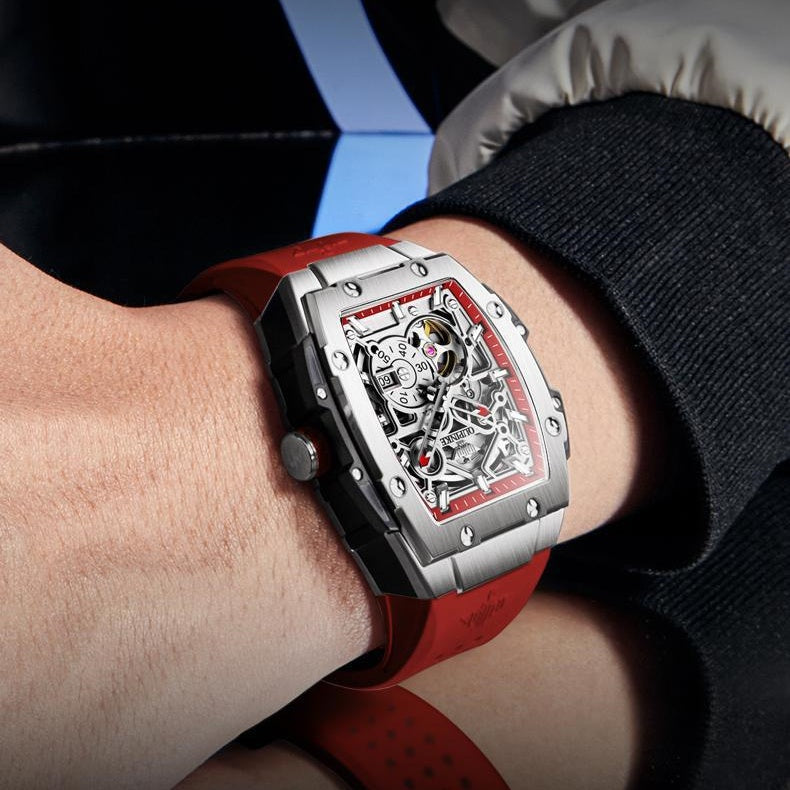
If you appreciate the engineering inside a watch, an automatic or skeleton design may be worth exploring. A skeleton watch makes parts of the mechanism visible, giving the wearer a more direct view of its movement.
Explore Gift Lux Watch's men's collection for different watch styles, including mechanical and skeleton designs. Check each product listing for the specific movement information available.
6. Servicing and Long-Term Ownership
Every mechanical watch may eventually need professional inspection or servicing. The timing and cost depend on the movement, its condition, the manufacturer's recommendations and the availability of parts and qualified watchmakers.
It is not accurate to claim that every Japanese movement is cheaper to maintain or that every Swiss movement is difficult to repair. Common calibers from either origin may be serviceable, but costs and parts access vary.
Before purchasing, consider:
- Whether the exact caliber is identified.
- Whether local watchmakers can service it.
- Whether replacement parts are available.
- What the warranty covers.
- Whether the seller offers a clear route for support.
For an everyday watch, after-sales support can matter as much as the movement's initial specification.
Swiss vs Japanese Automatic Movement: Which Should You Choose?
If you have narrowed your search to automatic watches, the comparison becomes more specific. An automatic movement uses a rotor to wind the mainspring through wrist movement. Many automatic movements can also be wound manually through the crown, depending on the caliber.
Choose based on your priorities rather than assuming one origin is always superior.
A Japanese Automatic May Suit You If:
- You want a practical mechanical watch at an accessible price.
- You prefer a movement from an established manufacturer such as Miyota or Seiko.
- You value straightforward ownership and want to check parts and service support before buying.
- You are interested in trying an automatic watch without paying extra purely for a Swiss label.
A Swiss Automatic May Suit You If:
- You specifically want a Swiss-made caliber or watch.
- You value a particular movement's finishing, frequency or complications.
- The watch provides clear specifications and suitable servicing options.
- The complete design and build justify its price for your needs.
Neither checklist is a guarantee of quality. A specific Japanese caliber can be a better fit than a specific Swiss caliber for one buyer, and the opposite can be true for another.
Swiss vs Japanese Quartz Movement
It is important to separate movement origin from movement type.
Quartz watches use an electronic oscillator regulated by a quartz crystal and normally run on a battery or another electrical power source. They generally offer very convenient, low-maintenance timekeeping.
Mechanical watches use a mainspring and a regulated mechanical system. Automatic watches wind through wrist movement, while manual-winding watches require winding by the wearer.
If you want a watch that is easy to wear every day and requires minimal interaction, quartz may be the better choice regardless of whether it is Swiss or Japanese.
If you enjoy mechanical engineering, winding and the movement of gears, an automatic watch may be more satisfying.
You can compare different designs in the Gift Lux Watch collection. Check each product's specifications to confirm whether it is quartz or mechanical before ordering.
How to Choose the Right Watch for Your Budget
Instead of paying for a country name alone, use this quick buying checklist.
1. Decide on quartz or automatic. Quartz suits buyers who prioritize convenience and consistent everyday timekeeping. Automatic suits buyers who enjoy mechanical watchmaking.
2. Check the caliber. Look for the manufacturer and model number. “Swiss movement” or “Japanese movement” by itself may not provide enough information to compare performance.
3. Compare the specifications. Check accuracy tolerance, power reserve, functions and any certification claimed by the manufacturer.
4. Evaluate the complete watch. Consider case material, crystal, strap or bracelet, water resistance, fit and finish.
5. Check the warranty and service options. Understand what is covered and where support is available.
6. Buy the design you will actually wear. Dial readability, case size, comfort and versatility have a direct effect on how much you enjoy the watch.
If you are buying a gift, style and everyday practicality may matter more than the movement's country of origin. For someone who loves mechanical details, an automatic or skeleton watch can make a particularly engaging choice.
Browse best-selling watches at Gift Lux Watch to compare available designs and price points.
Frequently Asked Questions
Is a Swiss movement better than a Japanese movement?
Not automatically. Both countries produce movements across different quality and price levels. The exact caliber, regulation, finishing, servicing options and intended use are more useful comparison points than nationality alone.
Are Japanese watch movements reliable?
Many Japanese movements are designed for dependable everyday use. Reliability still depends on the specific caliber, manufacturing quality, assembly, maintenance and how the watch is treated.
Is Miyota a good watch movement?
Miyota manufactures a wide range of movements. Whether a particular Miyota caliber is suitable depends on the functions and specifications you need. Check the exact model rather than treating the manufacturer's entire range as one specification.
Are Swiss automatic watches more accurate?
Not necessarily. Accuracy depends on the specific mechanical caliber, its grade, regulation and condition. A Swiss origin label alone does not establish a watch's daily rate.
Which is better for a first automatic watch: Swiss or Japanese?
Either can be a sensible choice. Compare the watch's actual movement, price, warranty and servicing options. A well-specified Japanese automatic may be a practical starting point, while a Swiss automatic may suit someone who has a particular caliber or watchmaking tradition in mind.
Do Japanese movements last as long as Swiss movements?
Both can provide long service when properly made and maintained. Lifespan depends on the movement, use, lubrication, servicing and availability of replacement parts—not just the country of origin.
Is a Swiss-made watch always better quality?
No. “Swiss-made” describes a regulated origin designation, not a universal quality grade. You should still check the movement, materials, assembly, accuracy claims and warranty of the individual watch.
Should I choose a quartz or automatic movement?
Choose quartz if you want convenient timekeeping with minimal routine interaction. Choose automatic if you appreciate mechanical engineering and are comfortable with daily rate variation and additional maintenance considerations.
Final Verdict: Swiss vs Japanese Movement
The best choice is the movement that meets your expectations for timekeeping, ownership cost, maintenance and design.
Japanese movements from manufacturers such as Miyota and Seiko offer options across a wide range of everyday and enthusiast watches. Swiss manufacturers such as ETA and Sellita also offer a range of mechanical and quartz solutions, including calibers used in more premium products.
Do not buy a watch simply because one country is said to be better. Compare the actual specifications, confirm the movement where possible, and choose a watch you will enjoy wearing.
Ready to find your next watch? Explore the men's watch collection, compare styles in the featured collection, or browse the best sellers to find a design that fits your everyday style.
Deployant Clasp: What It Is and How It Works
What Is a Tourbillon Watch? How It Works & Why It Costs More
Related Posts

What Is a Tourbillon Watch? How It Works & Why It Costs More

Deployant Clasp: What It Is and How It Works

How to Adjust a Watch Band: Step-by-Step Guide

5 ATM Water Resistance: What It Means for Your Watch

Which Wrist to Wear a Watch On? Left or Right?
How to Clean a Stainless Steel Watch Safely
